Posts

Adapting a Agile way of life.

There a quote by an anonymous author, "A frog in a well cannot discuss the ocean, because he is limited by the size of his well". We all are driven by our psychological mindset. And our psychological mindset is a collection of our observations during our upbringing, this is one of the reasons why everyone behaves differently. But have you ever thought we as a human have an ability to change our mindset just by changing our perspective to things and learning new methods to achieve peace and goals in life. Similarly, is the project and it's team members everyone has their own way's and methods of doing the task and we can never have everyone on same page from day one. So a Scrum master, Project Manager, Business Analyst role being a change managers is to drive this behavioral challenges and keep the team streamlines to project goals and to resolve any disputes amongst the team not by escalating it but just by observation and by driving them to anew direction of mi...

Design Thinking:

Image
This has been a pressing topic for any Business Analys / Project Manager while prototyping or while advising a solution design. Design thinking is about being into customer shoes and trying to identify if the applied approach is feasible or logical in nature for en customer to use it. Also, principels of desing thinking helps to review and desing the solution is a better way which can indirectly increase acceptance ratio. According to human psychology a good design is not glamorous, it's more of easy to use for the user. Desing thinking is more over a lean process. steps to be followed for design thinking are as below: Understand/Empathize Define Ideate Prototype Refine/Test Understand: During this phase being a client advisor individual should try to understand the pain points of current system/process. Individual should build empathy for the user while performing this phase. Techniques which can be used are; Understand the audience: Try to understand the stakeh...

Certifications and it's details

IIBA enlisted certifiactions a BA can go for with 5+ years of experience IIBA Fees (International Institute of Business Analysis) Membership: US$55/year - 3887.20 CBAP® (Certified Business Analysis Professional) - $450 - 31804.33 Application fee: $125 - 8834.54 Exam Fee: $325 - 22969.80 Prerequisites: Complete a minimum of 7,500 hours of Business Analysis Work experience in the last 10 years. Within this experience, a minimum of 900 hours completed in 4 of the 6 BABOK® Guide Knowledge Areas, for a total of at least 3,600 of the required 7,500 total. Complete a minimum of 35 hours of Professional Development in the last 4 years. Provide two references. The CBAP exam consists of 120 multiple choice questions and must be completed within 3.5 hours. Formulated from the BABOK® Guide, exam questions are both scenario and case study-based. This is a computer-based exam taken at a Prometric test center. To be admitted to the exam, your IIBA Profile Name must match your governm...

WBS - Work Breakdown Structure

Image
We have known multiple documents and plans used during project management like scope creep method, product backlog, charts, BRD, FRS and SDD. But to keep a track of project and deliverables we need is a tracker. WBS i.e. Work Breakdown Structure provides a detailed breakdown of tasks, resource requiredness and effort estimation. Depending upon organization how one prepares it i.e. tool used can differ. Commonly used tools are Ms Excel, Smartsheet & Google sheets. With reference to workbreakdownstructure A work breakdown structure (WBS) is a key project deliverable that organizes the team's work into manageable sections. The Project Management Body of Knowledge (PMBOK) defines the work breakdown structure as a "deliverable oriented hierarchical decomposition of the work to be executed by the project team." Dividing complex projects to simpler and manageable tasks is the process identified as Work Breakdown Structure (WBS). Usually, the project managers use this m...

Kanban !

Image
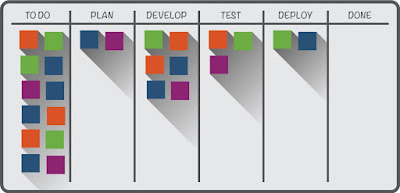
What is Kanban? Kanban is an Agile way of development just like Scrum being one. The main idea behind the Kanban system is to deliver what the process needs exactly when it needs it .The goal of Kanban is to identify potential bottlenecks in your process and fix them so work can flow through it cost-effectively at an optimal speed or throughput. The mantra is “Fail fast! Fail often!” As stated on Wikipedia Kanban(signboard or billboard in Japanese) is a scheduling system for lean manufacturing and just-in-time manufacturing (JIT). Taiichi Ohno, an industrial engineer at Toyota, developed kanban to improve manufacturing efficiency. Kanban is one method to achieve JIT. While kanban was introduced by Taiichi Ohno in the manufacturing industry, it is David J. Anderson who was the first to apply the concept to IT, Software development and knowledge work in general in the year 2004. The four foundational principles and six Core Practices of the Kanban Methodology are provided below:...

BurnDown vs BurnUp chart - Scrum

Image
Q. What is Scrum ? A: Scrum is an Agile approach of software development where software development is released in iterations (Incremental approach) and at the end complete product is delivered where customer needs are met unlike traditional waterfall approach where requirements can't be updated / modified during development cycle. There are various methods to track project status. Scrum uses BurnDown and BurnUp charts to track progress and demonstrate change using graphs.This helps in project forecasting as well. BurnDown Chart: A burn down chart is a graphical representation of work left to do versus time. The outstanding work (or backlog) is often on the vertical axis, with time along the horizontal. That is, it is a run chart of outstanding work. It is useful for predicting when all of the work will be completed. Progress on a Scrum project can be tracked by means of a release burndown chart. The ScrumMaster should update the release burndown chart at the end of each s...

Product Backlog VS Sprint Backlog

What is Product Backlog ? Product Backlog is a collection of list of items to be developed i.e. It is the list of functional and non-functional requirements ordered based upon the priority of requirement. In other words Product Backlog is simply a list of all things that needs to be done within the project. It replaces the traditional requirements specification artifacts. These items can have a technical nature or can be user-centric e.g. in the form of user stories. As per SCRUM, The Product Owner is responsible for the Product Backlog, including its content, availability, and ordering. A Product Backlog is never complete. The earliest development of it lays out the initially known and best-understood requirements. The Product Backlog evolves as the product and the environment in which it will be used evolves. The Product Backlog is dynamic; it constantly changes to identify what the product needs to be appropriate, competitive, and useful. If a product exists, its Product Backlog...